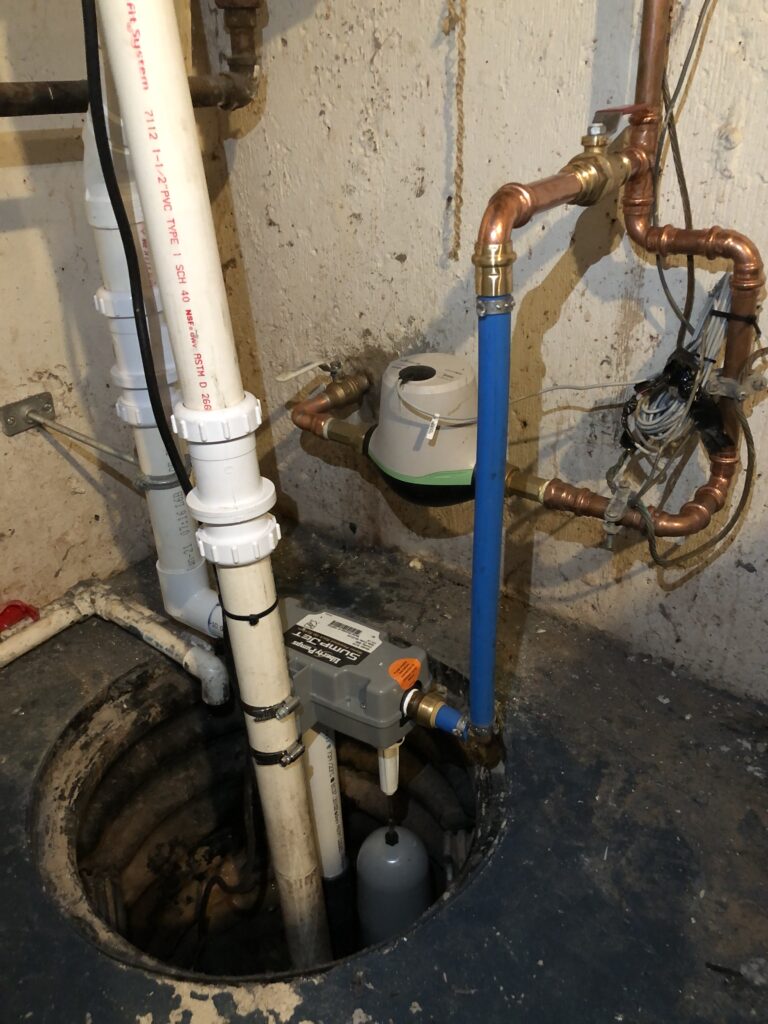
Quick answer: Choose a sump pump backup by the failure it must handle—not by its advertised runtime alone. A battery-powered secondary pump needs compatible equipment and sufficient stored energy. A water-powered backup needs adequate municipal water pressure, approved backflow protection and an acceptable discharge route. Neither is a complete answer to a blocked outlet or inflow beyond its pumping capacity. Confirm performance at your home’s conditions before buying. (zoellerpumps.com)
For U.S. homeowners. Product specifications and local examples checked November 29, 2026. This is a planning guide, not electrical or plumbing installation instructions.
1. Identify which failure you want the backup to cover
Ask each contractor to explain three situations separately:
- Power fails: What powers the pump, and for how long under the stated conditions?
- The primary pump or its switch fails: Is there a separate pump and activation mechanism?
- Water arrives faster than the primary pump can remove it: What capacity remains available, and can the discharge handle it?
A battery backup system with its own pump is different from equipment that merely supplies backup electricity to the existing pump. Restoring electricity does not repair a failed pump. Manufacturer documentation for the systems discussed here identifies separate backup pumps and their controls. (zoellerpumps.com)
Also ask what both pumps would still depend on. A shared discharge route deserves particular attention: Fargo’s water-reclamation guidance warns that a frozen outlet can cause pump failure and water to back up into a basement. A second pump does not remove that obstruction. (fargond.gov)
Practical check: Request a short written explanation of what still works when the primary pump cannot run, plus any conditions that could disable both systems.

2. Compare battery-backed and water-powered systems by their dependencies
| Decision point | Battery-powered secondary pump | Water-powered backup |
|---|---|---|
| Energy source | Stored battery energy | Pressurized municipal water |
| Main limitation to investigate | Battery capacity, condition and recharge arrangements | Available pressure and flow while operating |
| Compatibility question | Which battery and charger combinations are approved? | Is the supply suitable, and what backflow protection is required? |
| Ownership responsibility | Battery checks, testing and eventual replacement | Pump testing, water use and required backflow-device testing |
These distinctions follow the manufacturers’ operating requirements and extension guidance; they are not a ranking of particular products. (ag.ndsu.edu)
For a battery system, request the exact battery specification rather than accepting “battery included.” NDSU Extension advises selecting battery capacity in line with the backup-pump manufacturer’s recommendations. Do not assume a different battery chemistry or a larger battery is approved simply because it fits. (ag.ndsu.edu)
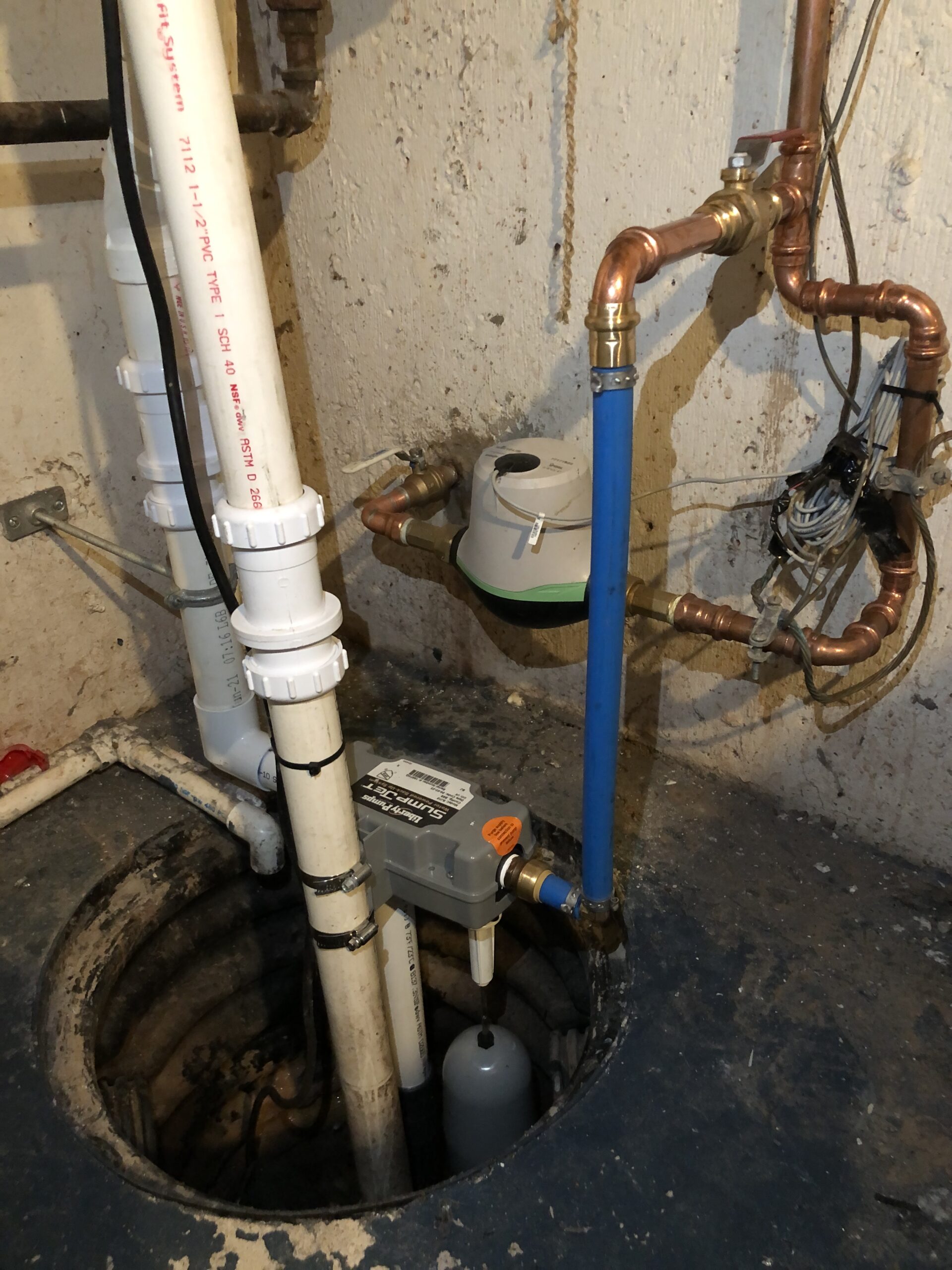
For water-powered equipment, establish supply suitability first. Liberty’s SumpJet manual specifies municipal water service. If your home uses a private well, treat that as a compatibility question—not permission to proceed. The system’s pressure requirements must also be assessed while water is flowing, not from a static-pressure reading alone. (libertypumps.com)
3. Require a performance curve, not just a maximum-flow number
A pump’s useful capacity depends on the conditions under which it operates. Ask the installer to document the proposed operating point on the manufacturer’s performance curve, including the discharge route and relevant pressure losses.
For example, Zoeller’s AquaNot Spin 508 technical sheet lists the following performance at 12.1 volts:
| Total dynamic head | Published flow |
|---|---|
| 5 feet | 39 U.S. gallons per minute |
| 10 feet | 30 U.S. gallons per minute |
| 15 feet | 20 U.S. gallons per minute |
| 20 feet | 6 U.S. gallons per minute |
The same pump therefore has substantially different capacity at different head conditions. These figures are manufacturer data, not a prediction for your basement. (zoellerpumps.com)
Water-powered curves add another variable: operating inlet pressure. Liberty’s May 2025 SJ10-series operating table lists 9 gallons per minute at 8 feet of lift and 30 psi, compared with 17 gallons per minute at the same lift and 60 psi, under its stated pipe conditions. Its curve specifies pressure measured with the valve open and water flowing. (libertypumps.com)
Request:
- The exact pump model and dated performance sheet.
- The installer’s discharge-head assumptions.
- For water-powered equipment, measured operating pressure and the effect of required supply components.
- The basis for the assumed incoming-water rate.
Common mistake: Comparing one pump’s maximum advertised flow with another pump’s output at a specified head. Ask for comparable operating conditions instead.

4. Separate pumping capacity from outage duration
Capacity answers, “Can it keep up?” Runtime answers, “How long can it continue?” Passing one test does not establish the other.
Battery-runtime claims need their test conditions attached. Zoeller’s technical sheet, for example, gives an approximate continuous-runtime estimate tied to a specified battery and explains that intermittent operation changes elapsed protection time. Do not convert that into a universal overnight or multiday promise. (zoellerpumps.com)
Worked example—illustrative assumptions, not a system design
Suppose an installer establishes that a proposed backup can deliver 20 gallons per minute at the planned operating conditions.
| Hypothetical outage | Assumed inflow | Calculation | Planning implication |
|---|---|---|---|
| Four hours, moderate inflow | 5 gallons/minute | 5 ÷ 20 = 25% pumping duty; approximately 60 minutes of pumping over four hours | Request battery evidence for that duty pattern |
| Four hours, heavier inflow | 15 gallons/minute | 15 ÷ 20 = 75% duty; approximately 180 minutes of pumping | Much greater energy demand |
| Any duration, excessive inflow | 25 gallons/minute | Inflow exceeds output by 5 gallons/minute | Stored energy cannot correct inadequate capacity |
This simplified arithmetic assumes steady inflow and constant output. It does not account for battery-voltage changes, controls or changing storm conditions.
For a water-powered proposal, add a water-use calculation. Midland, Michigan’s advisory describes approximately one gallon of municipal water consumed for every two gallons removed from the sump. At that illustrative ratio, removing 1,200 gallons would consume about 600 gallons of supply water and create about 1,800 gallons of combined discharge. Confirm the selected equipment’s consumption under the proposed conditions. (cityofmidlandmi.gov)
5. Resolve backflow protection and discharge approval before ordering
A water-powered pump connects drinking-water service to equipment handling non-potable sump water. Midland requires an RPZ backflow-prevention assembly meeting ASSE 1013 immediately before the water-driven sump pump. That is a specific jurisdictional example, not a nationwide approval rule. (cityofmidlandmi.gov)
Ask your water utility and plumbing authority:
- Is this equipment permitted at this property?
- Which backflow assembly is required?
- Are permits, inspection and initial testing necessary?
- Who must perform recurring tests, and how often?
Midland’s published program requires annual testing for these protection devices. Its separate irrigation-device exception should not be mistaken for the sump-pump requirement. (cityofmidlandmi.gov)
Resolve the outlet separately. Liberty’s SumpJet manual prohibits connecting that model’s discharge to the primary sump-pump discharge. A proposal that assumes an existing pipe can simply be reused therefore needs model-specific scrutiny. (libertypumps.com)
Disposal rules also vary. Michigan guidance requires the storm-sewer owner’s permission for a storm-sewer connection. Fargo generally directs sump discharge outdoors but offers a permitted seasonal sanitary-sewer bypass program. Neither example authorizes the same arrangement elsewhere. (michigan.gov)
Have the contractor explain freeze exposure, the receiving location and how discharge will avoid returning toward the foundation. South Dakota State University Extension warns that discharge near the house can recirculate through the foundation drainage system. (extension.sdstate.edu)
6. Compare itemized installation proposals with matching scopes
There is no useful universal installed price without a location, equipment selection and site assessment. Request current estimates in U.S. dollars with the property location, estimate date, exclusions and expiration date identified.
Use this comparison schedule:
| Requested line item | Hypothetical battery proposal | Hypothetical water-powered proposal |
|---|---|---|
| Equipment | Pump, controller, approved battery and enclosure | Pump and specified alarm package |
| Site assessment | Basin clearance and battery-location review | Basin clearance and operating-pressure assessment |
| Discharge work | Proposed route and permitted connections | Model-compliant route and combined-flow assessment |
| Supporting work | Qualified electrical work, if required | Water-supply work and approved backflow assembly |
| Approvals | Applicable permits and inspections | Applicable permits, inspections and backflow testing |
| Handover | Commissioning record and maintenance schedule | Commissioning record and testing responsibilities |
| Future costs | Battery replacement and service | Supply-water use, service and required device testing |
This is a scope template, not a quotation or a claim that every item applies.
Do not rank the totals until omissions are resolved. A battery proposal excluding the battery and a water-powered proposal excluding required backflow work are not complete comparisons. Ask each contractor to mark every line included, excluded, allowance or not applicable.
7. Specify alarms and assign a response
An alarm should have its own acceptance checklist. Ask the installer to identify:
- Which conditions trigger it: high water, backup activation, power loss, battery trouble or equipment fault.
- Whether it is audible locally, sends remote notifications, or both.
- What powers it during an outage.
- Whether remote notifications depend on household internet equipment.
- Who responds when nobody is home.
Do not infer alarm features from the pump’s brand name. Liberty’s published SJ10-series documentation distinguishes the basic SJ10 without an alarm from alarm-equipped variants. (libertypumps.com)
Request a demonstration of the purchased notification functions during commissioning. Also ask for a safe response plan. An alert is not a guarantee of continued pumping, and investigating water near electrical equipment is not an appropriate homeowner troubleshooting task. South Dakota State University Extension emphasizes electrical precautions around flooded-basement pumping. (extension.sdstate.edu)
8. Put maintenance responsibilities in writing
Before accepting the installation, request a schedule covering equipment tests, battery checks, alarm checks, discharge inspection and any required backflow certification.
Use the selected model’s instructions. Zoeller’s July 2025 Spin 508 manual calls for inspection and operational testing at least every three months, monthly electrolyte checks for wet-cell batteries, and battery replacement every three years. Those intervals are model-specific—not a maintenance rule for every backup system. (zoellerpumps.com)
For water-powered equipment, identify who arranges utility-required testing and retains the records. For either option, include seasonal outlet checks: Fargo warns that frozen or obstructed discharge piping can undermine pump operation. (cityofmidlandmi.gov)
Before buying, obtain five written answers: the failure covered, capacity at the proposed conditions, energy or water-supply assumptions, approved discharge arrangement, and maintenance owner. If any remains unresolved, request clarification before authorizing the purchase.